Storage & refuelling interface
Hydrogen-compatible storage, mounting, valves and refuelling interfaces selected for the vehicle and intended application.
 VTM INDIA ENERGYVISION · TECHNOLOGY · MOBILITY
Aftermarket hydrogen combustion conversion development for heavy-duty trucks and buses in India.
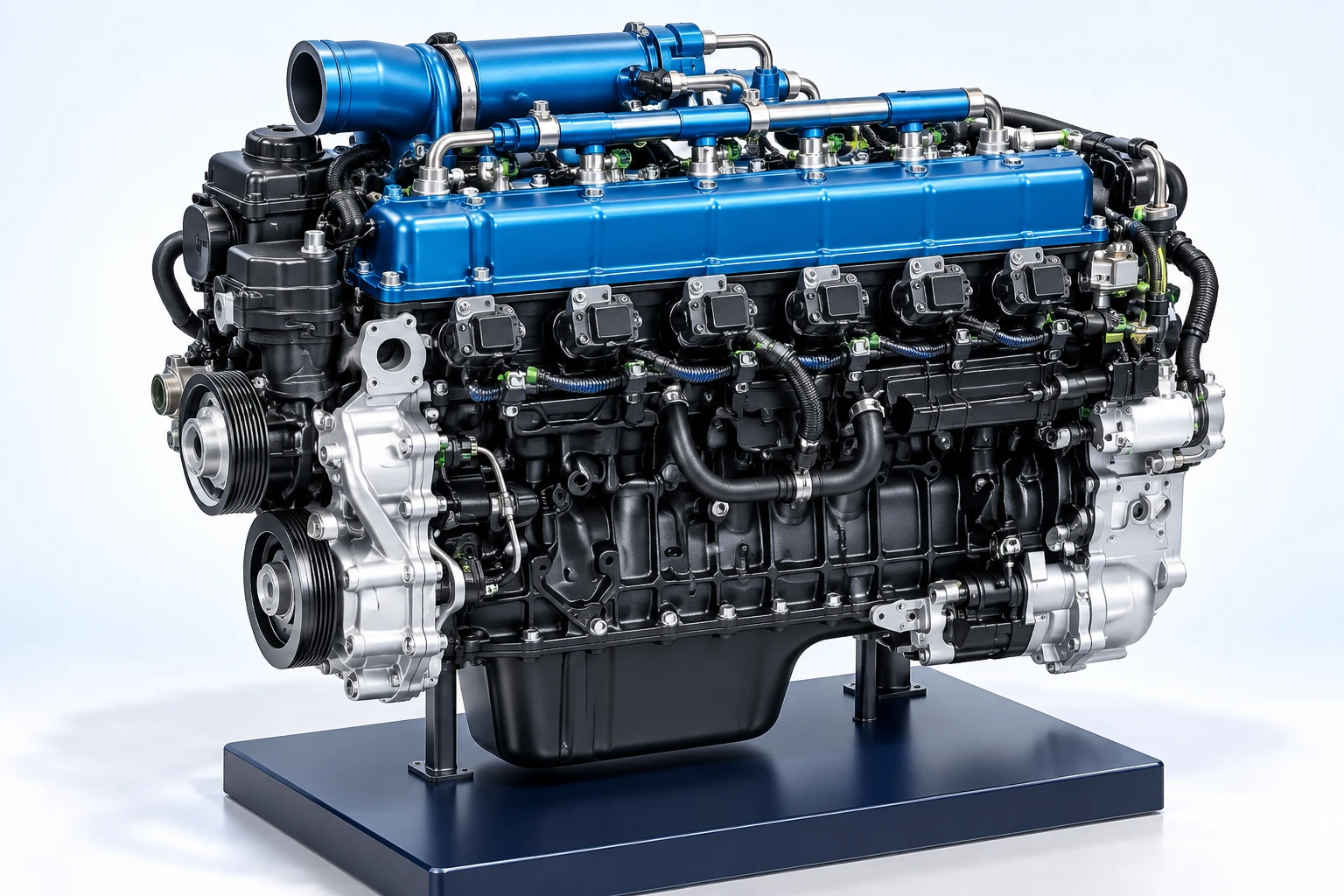
Development focus: the six-cylinder Ashok Leyland H6 diesel platform. VTM INDIA ENERGY is pursuing engine-specific hydrogen conversion engineering covering combustion, fuel delivery, ignition and electronic controls.
The programme covers dedicated hydrogen operation and diesel–hydrogen co-combustion. Each needs a different engine strategy, installation scope and validation plan.
| Development route | Hydrogen monofuel | Diesel + hydrogen |
|---|---|---|
| Operating concept | Dedicated hydrogen combustion through engine redesign or replacement. | Hydrogen supplements diesel while diesel ignition is retained. |
| Engine & controls | Suitable ignition, hydrogen injection, combustion design and ECU calibration. | Hydrogen metering coordinated with diesel operation and engine protection. |
| Project objective | Develop a dedicated hydrogen-fuelled heavy-duty powertrain. | Evaluate partial diesel displacement under a defined duty cycle. |
| VTM status | Development-stage programme. | Development-stage programme. |
These are separate development pathways. A conventional diesel engine cannot operate on hydrogen alone without substantial changes. There is no universally compatible retrofit kit.
Hydrogen-compatible storage, mounting, valves and refuelling interfaces selected for the vehicle and intended application.
Pressure regulation, isolation valves, filtration, hydrogen injectors and compatible delivery components.
Combustion assessment, ignition or diesel coordination, ECU calibration, sensors and diagnostic requirements.
Leak detection, ventilation assessment, shut-off strategy, pressure monitoring and system-level protection.
Indicative engineering scope, not a released VTM kit specification. Storage pressure, capacity, component ratings and bill of materials are determined only after platform assessment.
Review the engine, vehicle packaging, route, load profile and available hydrogen supply.
Define the system and assess performance, emissions, safety and durability on the selected platform.
Use pilot results to assess operating economics, maintenance and the applicable approval pathway.
Share the vehicle and engine model, rated power, emission stage, fleet size, daily distance and access to hydrogen.
Project pricing follows feasibility and scope definition. Fuel savings, range, performance and operating costs require validation; no fixed savings are promised.
Deployment depends on vehicle-specific testing, applicable approvals and hydrogen supply. Hydrogen combustion can produce NOx, so emissions control and testing remain part of the development scope.
Enquire about a pilot ↗